IT’S WEDNESDAY afternoon. My body aches as tension attacks. Internal dialogue continually plays in my head, preventing sleep from being a possibility. Then, finally, my cell phone rings, and I jump to answer. The invisible hands have grasped my throat once more as I see the 617 Massachusetts area code on my phone!
“Hi, yes, it’s Stephanie.” I nervously exclaim.
Dr H.’s deep voice explains the updated situation: “It looks like plan B is most likely to happen.” But, he continues, “The main issue is the approval of the ambulance service needed to go from Spaulding Rehabilitation Centre to Francis H. Burr Proton Therapy Centre at Mass General daily.”
“Why is this an issue?” I defeatedly ask.
Dr H explains, “The Canadian government has issues funding an American ambulance service when Canada has perfectly good ministry- regulated ambulances.”
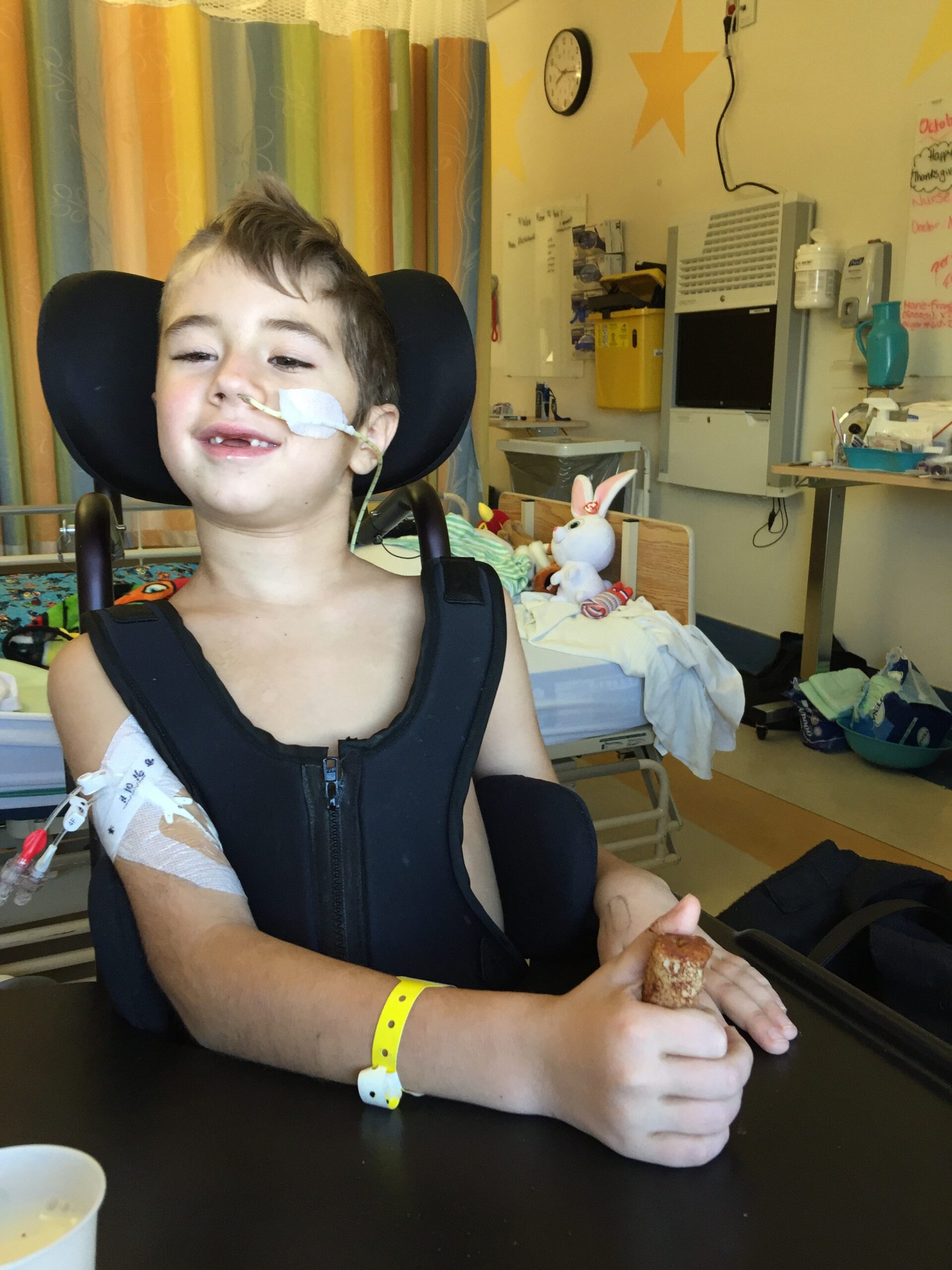
I had taken my son Aiden into the Children’s Hospital of Eastern Ontario (CHEO) twenty-one days ago for what I had been told for months was “viral fatigue.” My active seven-year-old had been sleeping for endless hours throughout the day. He was starting to have difficulty walking and was on round-the-clock Tylenol for headaches and Gravol to try and combat the nausea that was overwhelming to his young body. An MRI showed a tumour the size of a plum in Aiden’s developing brain. Surgery was performed immediately to release the pressure, and soon after, we were told that the tumour was cancer. The cancer had spread like a serpent down his spine, and “bad guys” spotted his brain. On autopilot, I have survived with a smile on my face to show strength and safety to my beautiful boy. It has been a tornado of doctors, research, waiting, and praying. Waiting to know the next steps and praying for treatment in Boston. Treatment will give us hope for Aiden’s future, for our family’s future. Finally, I am on the phone with the doctor from Boston, but hope is not yet guaranteed.
I exhale at the thought that the potential to give my son the best chance at survival and long-term quality of life is coming down to money. I am told the estimated cost for six weeks of transportation is $24,000. I cannot even begin to comprehend how I would ever come up with this amount. The potential to win the lottery seems very unlikely as I have not left the hospital in twenty-one days to even buy a ticket. The internal dialogue starts up with frantic questions. Do we need to pay upfront? Can we get the treatment and then just declare bankruptcy after? The thoughts swirl in my head as Dr H discusses the advantages of proton therapy, which is not yet available in Canada.
Proton radiation is generally expected to provide equivalent tumour control as Photon radiation offered here in Canada. It is sought out because it has been shown to substantially reduce the long-term effects through its targeted approach. Because Aiden is only seven and still very much developing, a targeted approach could save him from hearing loss, infertility, and the one that hurts the most, loss of independent living.
My heart splinters at this thought. Aiden’s cancer, Medulloblastoma, is one of the most common malignant brain tumours of childhood, but I have been told he has the fourth subtype, which is the worst. Medulloblastoma occurs in the cerebellum, also known as the “small brain,” located at the bottom of the back of the head. The cerebellum is involved in many aspects of human behaviour and function, such as movement, speech and breathing.
Dr H and I end our conversation with him, letting me know he is about to head to a round table debate to argue that the proton radiation and extensive rehabilitation are equally needed for Aiden.
“Can you and Aiden’s Dad try to decide, if it comes down to it, are you able to cover the transportation costs? If you could have an answer by four-thirty when I call back, then we can decide what the plan is.”
The air escapes my lungs as I whisper “Yes” and hang up the phone. Is this even at all feasible? I start to pray for a miracle. I head back into Aiden’s hospital room, curling up beside his tiny warm body on the children’s hospital bed. He nuzzles into my arms lovingly. I want to go back twenty-one days, I want to hear Aiden’s voice again, and I want to get embraced in his hug. I make jokes and try to get Aiden to laugh and smile. This has become a regular pastime of trying to be a comic and get any response I can. I am told automatic functions will come back first with posterior fossa syndrome, which has been true.
The fifteen-hour surgery, a week prior, to remove as much cancer as possible has stolen my sons’ ability to walk or talk. The surgery has left Aiden with what is called Posterior Fossa Syndrome. Posterior Fossa Syndrome only develops in approximately 25% of children after the surgical resection, but I guess Aiden won the horrible disease lottery and has developed the most severe case. Aiden needs to beat this horrible disease and needs the extensive rehabilitation that Spaulding Rehabilitation Centre can offer him.
The phone rings a bit past four-thirty p.m.; I tell Aiden I will be right back and head out of the room into the empty hall. It is Dr H. “Okay, so here it is … It has all been approved!”
“What? Wait a minute. Where is the, but?” I burst into tears.
“No, but,” he says, “it’s all been approved. The way they have worded the contract with the Ministry, it covers Aiden for any care he needs in any affiliated hospital, which Spaulding is!”
I am speechless. I thank him profusely and hang up. I head back into Aiden’s room, and the tears stream down my cheeks. The air in the room is electric as I tell Aiden and his Dad the fantastic news. Tears form in all our eyes, except Aiden’s, because he does not get the significance. I tell Aiden that he will get to ride on a “jet plane,” and a huge smile spreads across his face, and his eyes light up.
Although I am ecstatic, I self-talk myself down. I do not want to get my hopes up until I hear it from the oncology team at CHEO. I don’t think I can handle another ping-pong game. It is just after five-thirty, and I still have not heard from the team. I start to doubt my sanity as I send the caseworker an email, “Any word on Boston?” I don’t mention the conversation I had with Dr H earlier. I need to hear it for myself from this side. I put my phone away, it has been a long day, and I am depleted. I decided that I should probably eat something and start to head out of Aiden’s room. “Ding,” my phone chimes.
“Yes. Give us ten minutes and meet in the Sens Den.” Aiden is angelically asleep as his Dad and I head to the Sens Den, which is down the hall. Our emotions are running high. Aiden’s Dad and I are trying to be there for each other, but everything we say is getting lost in translation. Finally, the caseworker and interlink nurse, Marilyn, who has been a godsend for my sanity, arrives.
“It’s all been approved!” No beating around the bush. The words echo in my heart. “There is a little bit of paperwork to sign, and we are all quite shocked.” The caseworker continues, “We are told Aiden’s case went to the top of the Canadian health -care chain! There are a couple of requirements, such as flying Orange Air as it has a full medical staff, but everything looks good.”
I ask, “When we will leave?”
“Most likely, tomorrow morning, I am working on that piece right now. Aiden has a one p.m. appointment to prepare for the Proton Radiation in Boston on Friday.” I hug and thank Marilyn and the caseworker profusely; tears of relief and hope pour. We head back to Aiden’s room, and I tell his Dad in a panic that I need to see Declan before we go. The thought of not being with my other sons, Declan and Lynkon, is devastating. Lynkon is so tiny; will he even remember me? I try to balance it all but taking care of Aiden and trying to equally be there for our other boys has been an impossible feat. My friend brings Declan down to the hospital that night, and I fall asleep on the small cots with Declan in my arms.
I wake early; the sun is not up yet. I quietly get myself ready in the small bathroom next to Aiden’s bed, who sleeps peacefully. I start to pack as much as possible to make it easier for Aiden’s Dad. He will need to clear out the hospital and Ronald McDonald room when we leave. Our home for the last twenty-one days. I pack Aiden’s and my suitcase from the items we already have here. My phone rings at nine a.m., and I am told the plane is on the route and should be here around ten-thirty a.m. Declan sits with Aiden on his bed, showing him Pokémon cards as Aiden smiles. I look at the clock at twelve p.m.; my heart pounds profusely as a man for transport shows up and lifts Aiden to the stretcher. I hold Declan in my arms as he hugs me tight. “I want to go with you!” he cries on my shoulder. How can I explain to a five-year-old why he cannot come, why his mom is leaving him and why his brother is sick?
The transport man checks Aiden’s vitals one last time, and we all start to follow with sombre steps down the hall. I hold onto every moment we can all spend together, but we need to part ways. They lift the stretcher with Aiden strapped tightly onto the ambulance first. I follow and take a seat beside him. The doors of the ambulance close, and I can hear Declan’s piercing cry as I see him out the small window, engulfed in tears and in his dads’ arms.
I squeeze Aiden’s hand and mask my heart-wrenching pain with a reassuring smile to Aiden. Six weeks, I tell myself, six weeks, and this will all be a horrible dream we will wake up from and be back to normal.